
Root Canal Treatment: What It Is and What to Expect
Why a tooth ends up needing one, what actually happens in the chair, and how to look after it afterwards
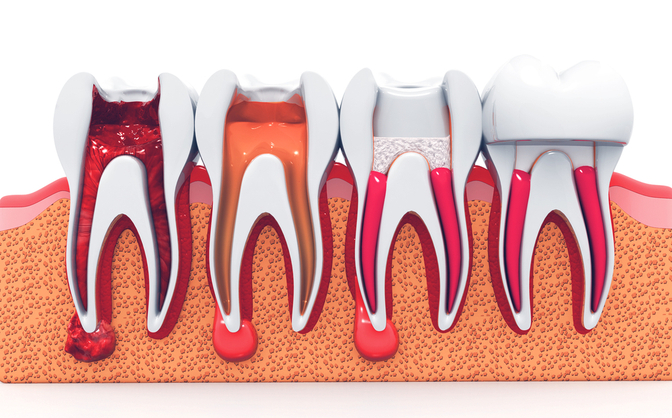
A root canal is how a dentist saves a tooth whose soft inner pulp has become inflamed or infected. The name worries a lot of people, but the treatment is usually what ends a toothache rather than what causes one.
Why a Tooth Needs a Root Canal
Every tooth has a soft core called the pulp. It holds the tooth's nerve and blood supply and runs down through narrow channels inside the roots — the root canals. The pulp is well protected until something breaks through the hard layers around it. The usual causes are:
- Deep decay that reaches the pulp
- A crack or chip that lets bacteria in
- A knock or injury to the tooth, sometimes years earlier
- Repeated large fillings or other work on the same tooth
Once bacteria reach the pulp, it cannot heal on its own. Left untreated, the infection can spread to the bone at the tip of the root and form an abscess.
Signs Worth Getting Checked
- A toothache that throbs or keeps coming back, especially when you chew or bite down
- Sensitivity to hot or cold that lingers after the food or drink is gone
- Swollen or tender gums around one tooth
- A small pimple-like bump on the gum near the tooth
- A tooth that has darkened or turned gray
None of these on its own means you need a root canal — a cracked filling or a gum problem can feel much the same — which is why the answer comes from an examination and an X-ray. It works the other way too: an infected tooth sometimes causes no pain at all and only shows up on an X-ray at a routine checkup.
When not to wait
Call us the same day if you have swelling in your face or jaw, a fever with tooth pain, or pain that keeps you awake.
If swelling spreads toward your eye or down your neck, or you have trouble breathing or swallowing, call 911 or go to the nearest emergency room. See emergency dental care for what to do in the meantime.
Three Myths About Root Canals
"Root canals are painful."
The pain people remember is usually the infection before treatment. During the procedure the tooth is numbed with local anesthetic, so most people feel pressure and vibration rather than pain, and many compare it to having a filling. It is normal for the tooth to feel tender for a few days afterwards.
"It would be easier to pull the tooth."
Sometimes extraction is the right choice. But keeping your own tooth lets you chew normally, stops the neighboring teeth drifting into the gap, and avoids the time and cost of replacing it with an implant or a bridge.
"It takes lots of appointments."
Many root canals are finished in a single visit. More complex teeth, such as molars with several curved canals, can take two. A crown to protect the tooth is usually fitted at a later appointment.
What Happens During Treatment
- Diagnosis. We examine the tooth and take digital X-rays, and 3D (CBCT) imaging when the canals need a closer look.
- Numbing. Local anesthetic numbs the tooth and the area around it. If you are anxious, ask about nitrous oxide or oral sedation.
- Cleaning. A small opening is made in the top of the tooth, the infected pulp is removed, and the canals are cleaned, shaped and disinfected.
- Sealing. The canals are filled with a biocompatible material called gutta-percha and sealed, and a temporary filling closes the opening.
- Restoring. A crown or a permanent filling protects the tooth for the long term.
For the full step-by-step, and how root canal treatment compares with having the tooth removed, see our root canal therapy page.
Why a Crown Usually Follows
A tooth that has had a root canal has lost its pulp and often a good deal of its structure to the original decay or damage. Back teeth take heavy chewing forces and can crack without protection, so they usually need a crown to cover and strengthen them. We'll tell you whether your tooth needs one.
Before and After Your Appointment
Before
- Tell us about any medical conditions, medicines and allergies.
- If you're having oral sedation, follow the eating and drinking instructions you're given, and arrange a ride home.
- Plan a quieter rest of the day if you can.
After
- Wait until the numbness wears off before eating, so you don't bite your cheek or tongue.
- Some tenderness for a few days is common. Use over-the-counter pain relief as we advise.
- Chew on the other side until the permanent crown or filling is in place.
- Keep brushing and flossing as normal, gently around the treated tooth.
- Call us if swelling or severe pain comes back, or the temporary filling comes out.
Common Questions
How long does a root canal take?
Most root canals take about 60 to 90 minutes. A tooth with several curved canals, such as a back molar, may need a second visit.
Can I go back to work the same day?
Most people can, once the numbness has worn off. If you had oral sedation, plan to rest for the rest of the day and have someone drive you home.
How long does a treated tooth last?
With a crown where one is recommended, good brushing and flossing, and regular checkups, a tooth that has had a root canal can last for many years.
What happens if I don't treat it?
An infected pulp does not heal on its own. The infection can spread to the bone around the root, and the tooth may eventually need to be removed.
A tooth that doesn't feel right?
Book an exam and we'll find the cause and talk you through your options.

About Dr. Nagarjuna Meesa
Owner & Dentist at Smile Makers of Georgia
Dr. Nagarjuna Meesa is the owner and lead dentist at Smile Makers of Georgia. A graduate of New York University's College of Dentistry and a member of the Academy of General Dentistry, he provides cosmetic and family dentistry in Alpharetta.