
TMJ Disorders: Causes, Symptoms and Treatment
Why your jaw hurts, clicks or locks, and what can help
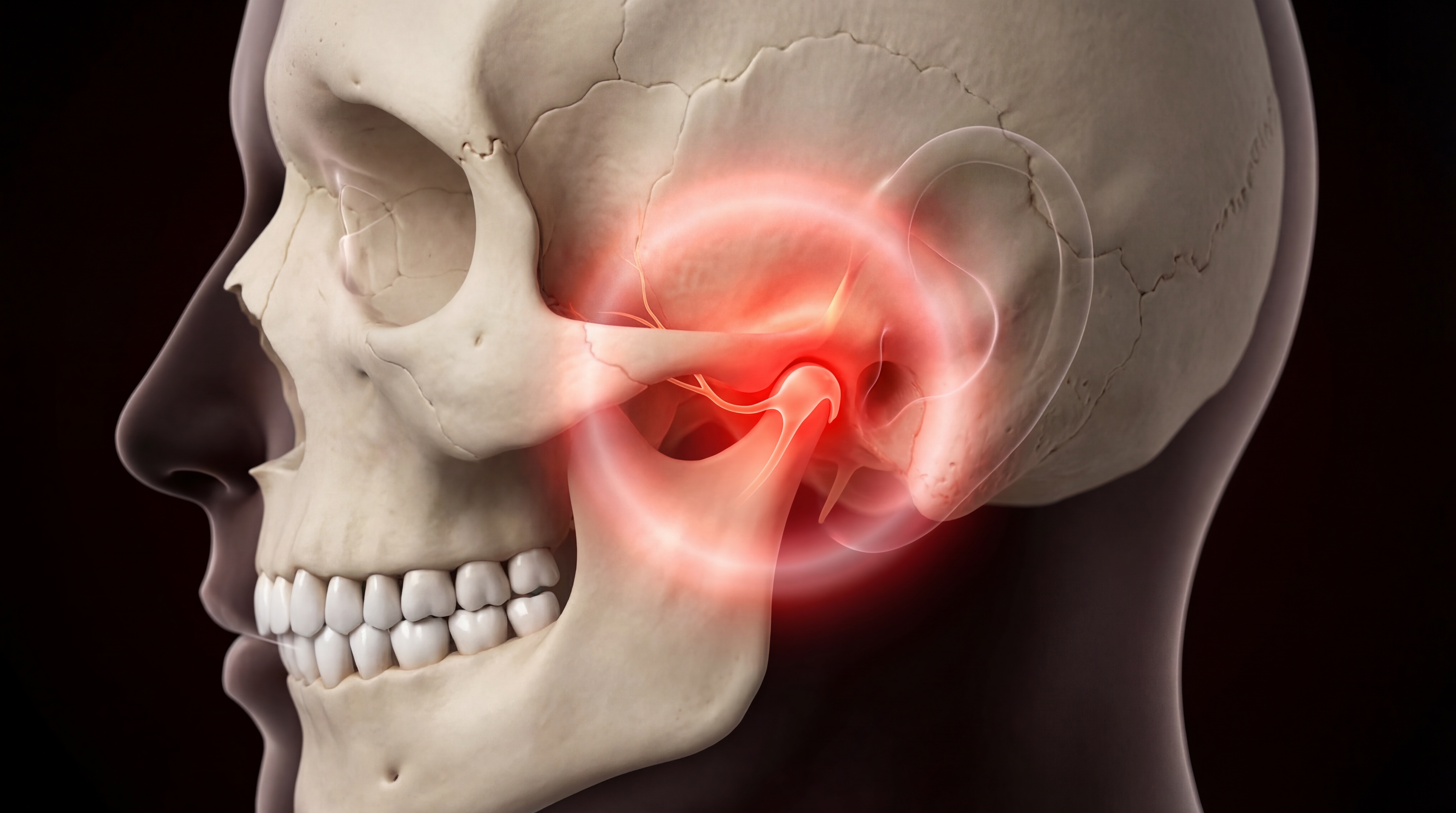
Your jaw joints work every time you talk, chew, swallow or yawn. When the joints or the muscles around them are strained, the result can be jaw pain, clicking, headaches or a jaw that won't open properly. This guide explains what's behind it, what an evaluation involves and what can help.
What Is a TMJ Disorder?
The temporomandibular joints, or TMJs, connect your lower jaw to your skull, one just in front of each ear. They both hinge and slide, which is what lets your jaw open wide and move from side to side. A problem with the joints or the chewing muscles that move them is called a temporomandibular disorder, or TMD — though most people simply call it "TMJ".
Common Symptoms
- Pain or tenderness in the jaw, in front of the ear or at the temples
- Clicking, popping or grating when you open or close your mouth
- A jaw that catches, or locks open or shut
- Difficulty opening wide, or pain when chewing
- Headaches, especially on waking
- Earache or a feeling of fullness in the ear without an ear infection
- Worn, chipped or sensitive teeth from grinding
What Causes It
- Grinding or clenching (bruxism), often at night and often without realizing it
- Stress, which tightens the jaw and neck muscles
- An injury to the jaw, face or head
- Arthritis in the joint
- Bite problems, such as teeth that don't meet evenly
Often several of these work together, which is why treatment usually combines more than one approach.
What Happens at a TMJ Evaluation
- We talk through what you've noticed, when it happens, and your health history
- We watch how your jaw opens, closes and moves from side to side
- We listen and feel for joint sounds
- We check the chewing muscles for tenderness, and your teeth for signs of wear
- When needed, we take X-rays or 3D images to see the joint itself
Treatment Options
Custom night guards and splints
A night guard is worn while you sleep to cushion grinding and clenching, protecting your teeth and easing the load on the joints and muscles. A splint is designed to hold the jaw in a more relaxed position and may be worn for longer periods. Both are made to fit your teeth.
BOTOX® for TMJ
Small injections into the chewing muscles relax the overactive muscles behind clenching, jaw tension and related headaches. The effect wears off over a few months, so treatment is repeated if it helps. It is often combined with a night guard. See TMJ therapy for how we provide it.
Jaw exercises and physical therapy
Gentle stretching and strengthening exercises can improve how the jaw moves and relax tight muscles. For some people, a referral to a physical therapist helps.
Short-term pain relief
Anti-inflammatory medicines or muscle relaxants may help during a flare-up, as advised by your dentist or doctor.
Addressing the bite
When an uneven bite, worn teeth or missing teeth are adding to the strain, we'll discuss whether restoring those teeth or straightening them with clear aligners makes sense for you.
When more is needed
Rarely, when the joint itself is damaged and other treatment hasn't helped, we refer patients to a specialist to discuss joint procedures.
Easing Jaw Pain at Home
- Eat softer foods and cut food into small pieces
- Avoid chewing gum, very chewy or hard foods, and ice
- Support your chin when you yawn, and avoid opening very wide
- Use a warm compress for aching muscles, or a cold one after an injury
- Rest your jaw with your lips together and teeth apart, and notice if you clench during the day
- Try relaxation techniques, and avoid resting your chin on your hand
When to See Us
- Jaw pain that lasts more than a couple of weeks, or keeps coming back
- A jaw that catches or locks, or is getting harder to open
- Headaches on waking, or someone tells you that you grind your teeth
- Teeth that look worn or chipped, or feel more sensitive
Get seen urgently if
your jaw is stuck open and won't close, or your jaw pain follows a blow to the face. Call us — or, if we're closed, go to the nearest emergency room.
Common Questions
Can a TMJ disorder go away on its own?
Mild jaw pain often settles within a few weeks with rest, soft foods and less clenching. Pain that keeps coming back, a jaw that catches or locks, or jaw trouble that affects eating or sleep is worth having checked, because the cause — often grinding — usually carries on until it is addressed.
My jaw clicks but doesn't hurt. Is that a problem?
Clicking on its own is common and often harmless. Mention it at your next checkup, and come in sooner if the clicking comes with pain, your jaw catches or locks, or opening your mouth gets harder.
Will a night guard help?
If grinding or clenching at night is part of the cause, a custom night guard can take pressure off the jaw joints and muscles and protect your teeth from wear. Guards bought off the shelf don't fit as closely as one made from a scan or impression of your teeth.
Is BOTOX® an option for TMJ pain?
It can be. Small injections relax the chewing muscles that clench and grind, which can ease muscle-related jaw pain and tension headaches. The effect wears off over a few months. We'll talk through whether it suits you at your evaluation.
Will I need surgery?
Very rarely. Most people are helped by the conservative treatments in this guide. Surgery is considered only when the joint itself is damaged and other treatment hasn't helped, and that would mean a referral to a specialist.
Jaw pain, clicking or morning headaches?
Book a TMJ evaluation and we'll look for the cause and talk through what could help.

About Dr. Nagarjuna Meesa
Owner & Dentist at Smile Makers of Georgia
Dr. Nagarjuna Meesa is the owner and lead dentist at Smile Makers of Georgia. A graduate of New York University's College of Dentistry and a member of the Academy of General Dentistry, he provides restorative, cosmetic and family dentistry in Alpharetta.